
Whether you're vegan, gluten-intolerant, keeping halal, or observing kosher, eating abroad shouldn't be a gamble. Yet too many travelers arrive at their destination with no idea whether their dietary needs will be understood — let alone accommodated. This guide rates 15 of the world's most-visited countries across five dietary categories so you can plan meals before you pack your bags.
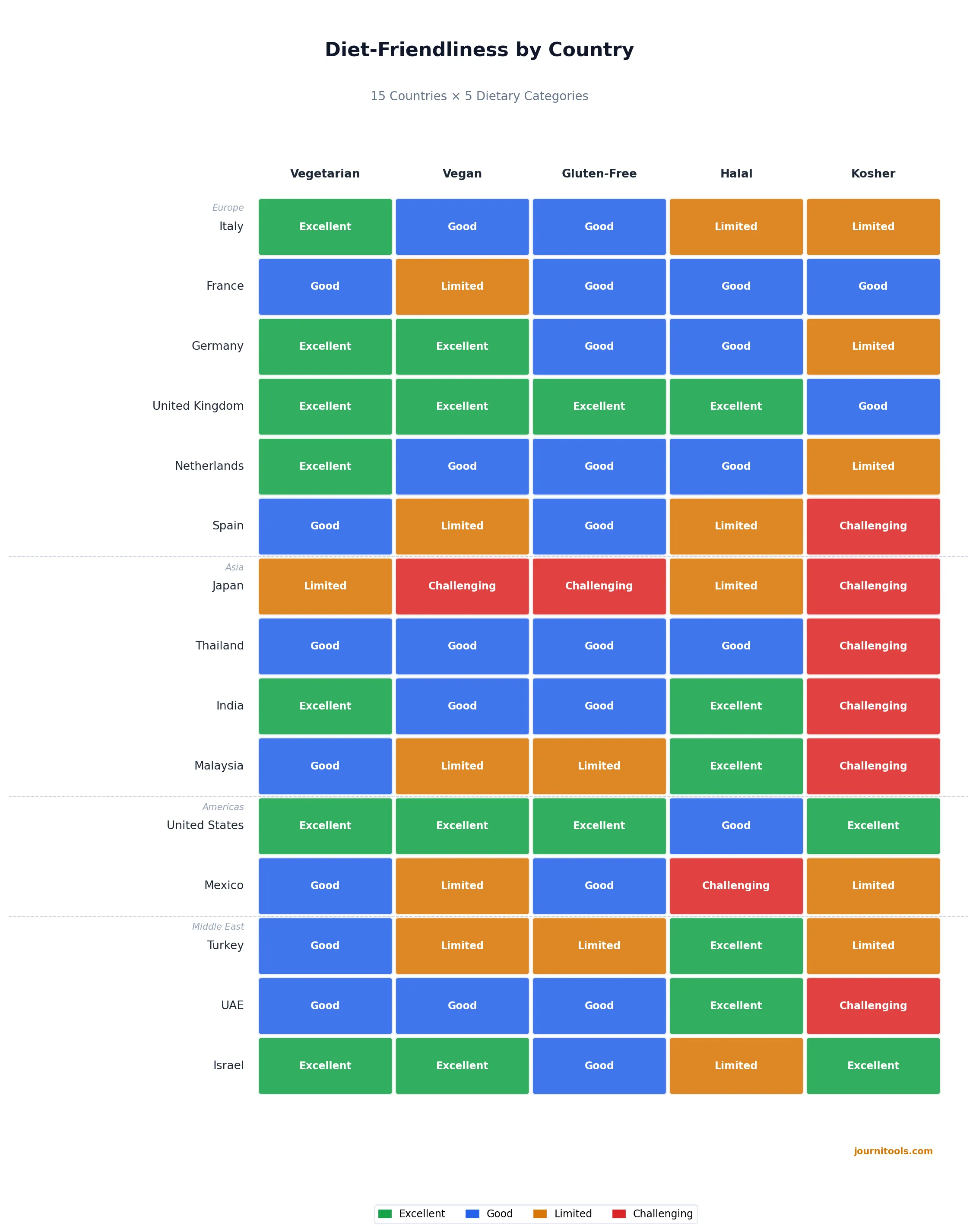
How We Rate Countries
Excellent
Widespread options, clear labeling, easy to eat out without worry.
Good
Solid options available with minor planning. Most cities have dedicated restaurants.
Limited
Options exist but require research. Expect language barriers and hidden ingredients.
Challenging
Very few dedicated options. Self-catering or pre-planned meals recommended.
At a Glance: Dietary Ratings by Country
| Country | Vegetarian | Vegan | Gluten-Free | Halal | Kosher |
|---|---|---|---|---|---|
| Italy | Excellent | Good | Good | Limited | Limited |
| France | Good | Limited | Good | Good | Good |
| Germany | Excellent | Excellent | Good | Good | Limited |
| United Kingdom | Excellent | Excellent | Excellent | Excellent | Good |
| Netherlands | Excellent | Good | Good | Good | Limited |
| Spain | Good | Limited | Good | Limited | Challenging |
| Japan | Limited | Challenging | Challenging | Limited | Challenging |
| Thailand | Good | Good | Good | Good | Challenging |
| India | Excellent | Good | Good | Excellent | Challenging |
| Malaysia | Good | Limited | Limited | Excellent | Challenging |
| United States | Excellent | Excellent | Excellent | Good | Excellent |
| Mexico | Good | Limited | Good | Challenging | Limited |
| Turkey | Good | Limited | Limited | Excellent | Limited |
| UAE | Good | Good | Good | Excellent | Challenging |
| Israel | Excellent | Excellent | Good | Limited | Excellent |
Europe
Italy
Abundant vegetable-first antipasti, dedicated gluten-free pasta in most restaurants. Ask for 'senza glutine' — awareness is high thanks to Italian celiac screening.
France
Paris leads with dedicated vegan bistros; outside the capital, expect cheese-heavy menus. Halal butchers are widespread in major cities. France has Europe's largest Jewish population, so kosher options are solid in Paris and Marseille.
Germany
Berlin is widely considered Europe's vegan capital with hundreds of plant-based restaurants. Turkish communities ensure halal food is easily accessible nationwide.
United Kingdom
The UK mandates allergen labeling in restaurants. Vegan options are standard on most menus. London has one of the world's most diverse halal food scenes.
Netherlands
Amsterdam's food scene is progressive — expect vegan menus at mainstream restaurants. Halal options cluster around the Schilderswijk and De Pijp neighborhoods.
Spain
Tapas culture makes customization easy but many classic dishes contain ham or seafood. Celiac associations are active, and 'sin gluten' menus are growing in Barcelona and Madrid.
Asia
Japan
Dashi (fish stock) hides in almost everything. Shojin ryori (Buddhist temple cuisine) is the safest bet for vegans. Halal-certified restaurants are growing near tourist hubs. Soy sauce contains wheat — a pitfall for gluten-free travelers.
Thailand
Buddhist culture means 'jay' (เจ) vegetarian food is widely understood, especially during festivals. Southern Thailand is predominantly Muslim with abundant halal options. Thai cooking is naturally gluten-light (rice-based).
India
India has the world's largest vegetarian population. Menus often label dishes as 'veg' or 'non-veg.' Halal meat is default in Muslim-owned restaurants. Dairy is ubiquitous — vegans should specify 'no ghee, no paneer.'
Malaysia
Malaysia has one of the world's most rigorous halal certification systems (JAKIM). Chinese and Indian neighborhoods offer vegetarian variety. Soy sauce and oyster sauce are common — check labels for gluten and shellfish.
Americas
United States
Major cities rival London for dietary diversity. Allergen menus are standard. Whole Foods, Trader Joe's, and dedicated vegan chains make self-catering easy. New York and Los Angeles lead for kosher and halal density.
Mexico
Corn-based cuisine is naturally gluten-friendly. Vegetarian options are plentiful (bean tacos, nopales, esquites) but lard and chicken broth hide in unexpected places. Halal and kosher options concentrate in Mexico City.
Middle East
Turkey
As a Muslim-majority country, virtually all meat is halal. Meze culture offers many vegetable dishes, but butter and yogurt are standard. Bread is central — gluten-free travelers will need to plan ahead.
UAE
Dubai is a global food hub with dedicated vegan restaurants, certified halal kitchens (standard for all local restaurants), and growing gluten-free awareness. The international dining scene ensures options for every dietary need.
Israel
Tel Aviv is often called the vegan capital of the world per capita. Kosher restaurants are the norm. Gluten-free awareness is high. Halal options are available mainly in East Jerusalem and Arab towns.
Essential Dietary Phrases
Save or screenshot this table before you travel. Being able to communicate your dietary needs in the local language can mean the difference between a safe meal and a risky one.
| Language | "I'm vegetarian" | "I'm vegan" | "Gluten-free, please" | "No meat" |
|---|---|---|---|---|
| French | Je suis végétarien(ne) | Je suis végétalien(ne) | Sans gluten, s'il vous plaît | Pas de viande |
| Spanish | Soy vegetariano/a | Soy vegano/a | Sin gluten, por favor | Sin carne |
| Italian | Sono vegetariano/a | Sono vegano/a | Senza glutine, per favore | Senza carne |
| German | Ich bin Vegetarier/in | Ich bin Veganer/in | Glutenfrei, bitte | Ohne Fleisch |
| Japanese | Bejitarian desu (ベジタリアンです) | Biigan desu (ビーガンです) | Guruten furii o onegai shimasu (グルテンフリーをお願いします) | Niku nashi de (肉なしで) |
| Thai | Gin jay (ฉันกินเจ) | Mai sai neua sat (ไม่ใส่เนื้อสัตว์) | Mai mee gluuten (ไม่มีกลูเตน) | Mai sai neua (ไม่ใส่เนื้อ) |
| Arabic | Ana nabati (أنا نباتي) | Ana nabati sarf (أنا نباتي صرف) | Bidun ghluten (بدون غلوتين) | Bidun lahm (بدون لحم) |
| Turkish | Vejetaryenim | Veganım | Glütensiz, lütfen | Etsiz |
| Hindi | Main shakahari hoon (मैं शाकाहारी हूँ) | Main veegan hoon (मैं वीगन हूँ) | Gluten-mukt, kripaya (ग्लूटेन-मुक्त, कृपया) | Bina maas (बिना मांस) |
| Hebrew | Ani tzimkhoni/t (אני צמחוני/ת) | Ani tiv'oni/t (אני טבעוני/ת) | L'lo gluten, bevakasha (ללא גלוטן, בבקשה) | B'li basar (בלי בשר) |
Plan Your Dietary Travel with JourniTools
Check dietary dining options for 40+ cities, find halal restaurants across Europe, and learn survival phrases in 60+ languages — all free, no signup required.
Frequently Asked Questions
Which country is best for vegan travelers?
The United Kingdom, Germany (especially Berlin), and Israel (especially Tel Aviv) consistently rank as the most vegan-friendly destinations. All three feature widespread plant-based restaurant options, clear menu labeling, and grocery stores with extensive vegan product ranges.
Is it safe to travel with celiac disease?
Yes, with preparation. Countries like the UK, Italy, and the United States have strong allergen labeling laws. Carry a translated 'celiac card' explaining your condition in the local language, and use JourniTools' Language Phrases feature to learn key phrases. Avoid soy sauce in East Asia (it contains wheat) and be cautious with shared cooking surfaces.
Where can I find halal food in non-Muslim countries?
Major European cities — London, Paris, Berlin, and Amsterdam — all have thriving halal food scenes, largely thanks to established Muslim communities. In the US, New York, Chicago, and Los Angeles have excellent halal options. Use JourniTools' Dietary Dining tool to check halal availability for specific cities before you travel.
How do I communicate dietary needs when I don't speak the language?
Carry a printed or saved 'allergy card' in the local language. JourniTools provides survival phrases for 60+ countries — including dietary-specific phrases. In East Asia, apps with picture-based menus can also help. Always confirm by pointing to written text rather than relying on verbal communication alone.
What's the hardest country to travel in as a vegetarian?
Japan and Argentina are among the trickiest. Japan's dashi (fish stock) is in most dishes, even seemingly vegetarian ones. Argentina's food culture is centered on beef, and vegetarian options outside Buenos Aires are sparse. In both countries, research restaurant options in advance and learn key phrases to communicate your needs.