International Travel With Mobility Issues: What Guidebooks Don't Tell You
New 2025 air travel rights, the lithium battery rule that gets people denied boarding, accessibility apps that beat Google Maps, and a 10-language phrase card for ramps, restrooms, and your wheelchair battery.
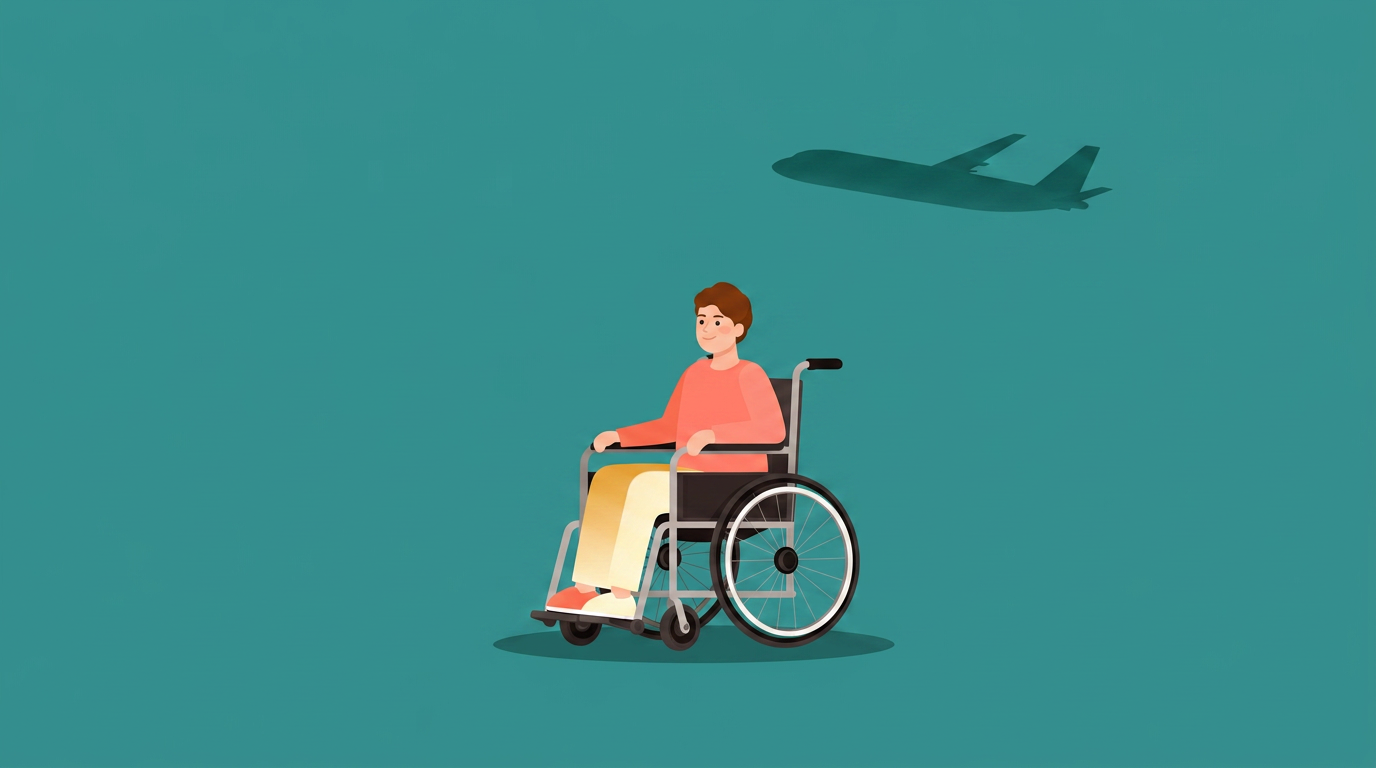
The seven things that actually matter
- Photograph your wheelchair before every flight, and file damage reports before leaving baggage claim.
- Carry the printed watt-hour (Wh) spec sheet for your battery, and confirm in writing with each airline on your itinerary.
- Book direct flights — every transfer multiplies the chance of damage.
- Use AccessNow, iAccessLife and Wheel the World instead of trusting hotel marketing.
- Pick up a Hidden Disabilities Sunflower lanyard at the airport before you fly.
- If you rely on a scooter in Europe, pack a collapsible manual chair as backup.
- Know your CRO (Complaint Resolution Official) right under the new 2025 US DOT rule.
If you use a wheelchair or a mobility scooter, you already know that traveling internationally with limited mobility rewards preparation far more than spontaneity. You've probably had the gate agent who couldn't answer a battery question, the "accessible" hotel room with a step into the bathroom, or the curb that turned a ten-minute walk into a forty-minute detour. The good news: most of the worst surprises are preventable once you know what changed under the 2025 US Department of Transportation rule, what to put in writing before you fly, and which apps disabled travelers actually built and use.
This guide is written for you — whether you're flying with a power wheelchair internationally for the first time, planning a trip for an aging parent, or returning to travel after an injury. You'll learn your new air-travel rights, how lithium battery rules really work, the accessible-travel apps that beat Google Maps, the wheelchair-accessible hotel room questions to ask before you book, and a 10-language phrase card you can hand to a hotel clerk or restaurant host.
A note on jargon: CRO = Complaint Resolution Official, an airline staff member legally required to handle disability complaints in real time. WAV = Wheelchair-Accessible Vehicle. DME = Durable Medical Equipment (chairs, scooters, etc.). Wh = watt-hours, the unit airlines use to limit lithium batteries.
Your new air travel rights (2025 US DOT rule)
A landmark U.S. Department of Transportation rule that took effect in January 2025 added protections most travelers — and most gate agents — still don't know about. Three changes matter most:
- When you check a wheelchair or scooter, the airline must notify you in writing that you have the right to contact a Complaint Resolution Official if your device is mishandled. Insist on this notification and keep it.
- Before you deplane, the airline must tell you whether your wheelchair has been unloaded from cargo. If it hasn't, you can wait at the gate rather than be stranded mid-jet-bridge.
- If your mobility device is delayed, the airline must reimburse ground transportation expenses caused by that delay — a clause almost no travel blog has covered yet.
Document everything. Save boarding passes, written notices, photos, and receipts; if you need to escalate, the paper trail is what wins.
Document your chair before every flight
Airlines moved more than 907,000 wheelchairs and scooters in 2025 with an industry-wide mishandling rate of about 1.09% — that's still thousands of damaged devices a year. Treat photographic documentation as non-optional:
- Photograph the chair from all sides at the gate, including joystick, footrests, casters, and any add-on bags.
- Photograph the battery and any tags showing watt-hours or "lithium-ion".
- If you find damage at your destination, file a written report with airline staff before leaving the baggage claim area. Reports filed later are far harder to win.
- If you can choose a U.S. carrier, Delta currently has the strongest mishandling record, though every airline has bad days.
The hidden battery rule that gets people denied boarding
Power chair and scooter batteries fall under international lithium-battery rules, and those rules vary by airline and country. Travelers are routinely denied boarding at the gate because they couldn't produce a spec sheet — not because their battery actually failed any rule.
- Carry a printed spec sheet showing the battery's watt-hour (Wh) rating and chemistry (typically lithium-ion).
- Confirm with each airline on your itinerary in writing — codeshare partners often have stricter limits than the airline you booked with.
- If you're switching carriers mid-trip, send the spec sheet to the disability desk of every airline before you leave home.
- If the battery is removable, know how it detaches; some airlines require it transported in the cabin in a specific protective case.
The "scooter problem" Europeans don't warn you about
In much of Europe, mobility scooters are legally treated as a convenience item rather than a medical necessity — the opposite of how they're treated in the United States. The practical consequence: scooter-style devices are barred from many museums, cathedrals, and public buildings, and you may be asked to walk a short distance or transfer to a manual wheelchair to enter.
If your trip relies on a scooter, pack (or rent on arrival) a collapsible manual wheelchair as a backup. This single decision rescues more European itineraries than any other.
Crowdsourced accessibility apps that beat Google Maps
Hotel websites and Google Maps describe accessibility the way restaurants describe portion sizes — generously. Apps built by disabled travelers fill the gap with photos, ratings, and step counts:
- AccessNow — global directory of public places rated by disabled users for ramps, restrooms, doorways, and seating.
- iAccessLife — accessibility ratings for 10,000+ locations across 30+ countries, plus an anonymous voice-feedback tool that pushes complaints to businesses.
- Wheel the World — for accommodation: properties are personally verified for door width, bed height, roll-in showers, and elevator access.
None of them have full global coverage. Cross-check at least two before you book anything important.
The Hidden Disabilities Sunflower (underused outside the UK)
The Hidden Disabilities Sunflower is now active in 230+ airports worldwide. You wear a green lanyard with a sunflower pattern, and trained staff recognize it as a discreet signal that you may need extra time, a quieter route through security, or assistance — without having to explain a condition out loud.
Lanyards are usually free at airport information desks (and increasingly at participating hotels and museums). It's familiar to UK travelers but still nearly unknown in North America and Asia, even though the airports recognize it. Pick one up at your departure airport on your first trip; you can reuse it forever.
Wheelchair-accessible rideshare: verify before you rely
In a handful of cities — New York, London, Los Angeles, Chicago — Uber's WAV (Wheelchair-Accessible Vehicle) option works reasonably well. Outside those cities, including most of continental Europe and Asia, WAV requests are slow, expensive, or non-existent.
- Test the WAV option in your destination from home, well before you fly.
- Look up dedicated accessible-transport services for your destination city; most major cities have one operator that disabled locals trust.
- For airport transfers, pre-book a confirmed accessible vehicle — don't gamble on rideshare with luggage and a chair after a long flight.
Booking accommodation: ask the right questions
"Accessible room" means very different things in different countries. Don't book on the label alone. Email or call and get specific answers to:
- Door width — minimum 32 inches (81 cm) for most chairs; wider for power chairs.
- Bed height — critical for transfers; ask in centimeters and inches.
- Bathroom — roll-in shower or tub? Where are the grab bars?
- Elevator-to-room distance — long corridors and uneven floor transitions defeat "accessible" rooms.
- Step-free entry to the building — surprisingly often missed.
- Power outlets near the bed — for charging a power chair overnight.
Ask for photos of each. A property that won't send them is telling you something.
Direct flights matter more than people think
Mobility devices are loaded and unloaded at every stop. Damage risk is roughly proportional to the number of times your chair is handled, so a non-stop flight that costs $150 more is often a better deal than a connection that breaks your $8,000 power chair. Treat the price difference as an accessibility insurance premium.
Consider renting equipment at your destination
If your trip is more than a few days and you're flying long-haul, renting a power chair or scooter at your destination can be cheaper, faster, and far less stressful than transporting your own. Wheel the World and local DME providers in major cities make this practical for most popular destinations. Your chair stays safe at home; if the rental fails, the rental company replaces it.
What's coming: flying in your own chair
Delta Air Lines, the FAA, and the DOT have been working toward a future where wheelchair users can remain seated in their own wheelchair on board. Pilot programs and regulations are in progress; if it ships, it will be transformative — eliminating the riskiest moments of air travel (transfers and cargo handling) at a stroke. Worth tracking before booking your next big trip.
Mobility phrase card (10 languages)
Show this on your phone or print it. Romanized pronunciations are in parentheses for non-Latin scripts. Replace [X] with your actual battery rating in watt-hours.
| Language | "I use a wheelchair." | "Is there a ramp or elevator?" | "Where is the accessible restroom?" | "Please help me, I cannot stand for long." | "My wheelchair battery is lithium-ion, [X] Wh." |
|---|---|---|---|---|---|
| Spanish | Uso una silla de ruedas. | ¿Hay una rampa o un ascensor? | ¿Dónde está el baño accesible? | Por favor, ayúdeme. No puedo estar de pie mucho tiempo. | La batería de mi silla es de iones de litio, [X] vatios-hora. |
| French | J'utilise un fauteuil roulant. | Y a-t-il une rampe ou un ascenseur ? | Où sont les toilettes accessibles ? | Aidez-moi s'il vous plaît, je ne peux pas rester debout longtemps. | La batterie de mon fauteuil est lithium-ion, [X] wattheures. |
| German | Ich benutze einen Rollstuhl. | Gibt es eine Rampe oder einen Aufzug? | Wo ist die barrierefreie Toilette? | Bitte helfen Sie mir, ich kann nicht lange stehen. | Mein Rollstuhl-Akku ist Lithium-Ionen, [X] Wattstunden. |
| Italian | Uso una sedia a rotelle. | C'è una rampa o un ascensore? | Dov'è il bagno accessibile? | Per favore, mi aiuti. Non posso stare in piedi a lungo. | La batteria della mia sedia è agli ioni di litio, [X] wattora. |
| Portuguese | Eu uso uma cadeira de rodas. | Há uma rampa ou um elevador? | Onde fica o banheiro acessível? | Por favor, me ajude. Não consigo ficar de pé por muito tempo. | A bateria da minha cadeira é de íon-lítio, [X] watts-hora. |
| Japanese | 車椅子を使っています。 (Kuruma-isu o tsukatte imasu.) | スロープかエレベーターはありますか? (Surōpu ka erebētā wa arimasu ka?) | バリアフリーのトイレはどこですか? (Bariafurī no toire wa doko desu ka?) | 助けてください。長く立てません。 (Tasukete kudasai. Nagaku tatemasen.) | 車椅子のバッテリーはリチウムイオン、[X]ワット時です。 (Kuruma-isu no batterī wa richiumu-ion, [X] watto-ji desu.) |
| Mandarin | 我使用轮椅。 (Wǒ shǐyòng lúnyǐ.) | 有坡道或电梯吗? (Yǒu pōdào huò diàntī ma?) | 无障碍洗手间在哪里? (Wúzhàng'ài xǐshǒujiān zài nǎlǐ?) | 请帮我,我不能久站。 (Qǐng bāng wǒ, wǒ bùnéng jiǔ zhàn.) | 我的轮椅电池是锂离子,[X]瓦时。 (Wǒ de lúnyǐ diànchí shì lǐ lízǐ, [X] wǎ shí.) |
| Korean | 저는 휠체어를 사용합니다. (Jeoneun hwilcheoreul sayonghamnida.) | 경사로나 엘리베이터가 있나요? (GyeongsaroNa ellibeiteoga innayo?) | 장애인 화장실은 어디에 있나요? (Jang-aein hwajangsileun eodie innayo?) | 도와주세요. 오래 서 있을 수 없습니다. (Dowajuseyo. Orae seo isseul su eopseumnida.) | 제 휠체어 배터리는 리튬이온, [X]와트시입니다. (Je hwilcheo baeteorineun ritium-ion, [X] wateusi imnida.) |
| Arabic | أستخدم كرسيًا متحركًا. (Astakhdim kursiyan mutaharrikan.) | هل يوجد منحدر أو مصعد؟ (Hal yūjad munhadar aw misʿad?) | أين الحمام المخصص لذوي الاحتياجات الخاصة؟ (Ayna al-hammām al-mukhassas li-dhawī al-ihtiyājāt al-khāssa?) | ساعدني من فضلك، لا أستطيع الوقوف طويلاً. (Sāʿidnī min fadlik, lā astatīʿ al-wuqūf tawīlan.) | بطارية كرسيي ليثيوم أيون، [X] واط/ساعة. (Battāriyat kursīy līthiyūm ayyūn, [X] wāt-sāʿa.) |
| Turkish | Tekerlekli sandalye kullanıyorum. | Rampa veya asansör var mı? | Engelli tuvaleti nerede? | Lütfen yardım edin, uzun süre ayakta duramam. | Sandalyemin bataryası lityum-iyon, [X] vat-saat. |
Pre-flight checklist
- ☐ Battery spec sheet (Wh + chemistry), printed
- ☐ Written confirmation from each airline on the itinerary
- ☐ Photos of chair from all sides, taken at the gate
- ☐ CRO awareness — know who to ask for if there's a problem
- ☐ Hidden Disabilities Sunflower lanyard
- ☐ Accommodation accessibility confirmed in writing (with photos)
- ☐ Backup collapsible manual wheelchair (especially for Europe)
- ☐ Pre-booked accessible airport transfer at destination
- ☐ Local accessible-transport service phone number saved offline
- ☐ AccessNow / iAccessLife / Wheel the World installed and signed in
A working data plan the moment you land matters even more when you're managing a chair, a battery, and a transfer. An eSIM activates before wheels-down — no SIM swap, no kiosk.
Related reading & tools
Senior Travel Guide
Practical international travel for travelers 60+.
Read guideLong-Haul Flight Health
DVT, sleep, hydration and jet lag with citations.
Read articleSmartphone Travel Checklist
60-item prep checklist for international trips.
Open checklistEmergency Numbers Worldwide
Save the right numbers offline before you fly.
Read article