The first time I got tipping wrong abroad, it was in a tiny tempura counter in Tokyo. The meal had been quietly perfect — batter so light it barely registered, miso that tasted like it had been simmering since I was born. I left about 15% on the little tray with the bill and walked out feeling generous. Thirty seconds later the server was on the sidewalk beside me, holding out my cash with both hands and a look of gentle distress, convinced I'd forgotten my change. In Japan I'd just done something roughly equivalent to telling my host their cooking needed work.
A few years later I made the mirror-image mistake — under-tipping at a diner outside Austin because I'd been living in Europe and had lost the American reflex. Same action, opposite reaction: same-day glare instead of same-day chase. Tipping is one of the most inconsistent social norms on the planet, and getting it wrong can range from mildly awkward to genuinely offensive.
This guide is the reference sheet I wish I'd printed before that first Tokyo dinner — 30 countries, organized by region, with specific percentages for restaurants, taxis, and hotels. Each country links to its full destination guide on JourniTools so you can keep researching.
Tipping Guide: 30 Countries at a Glance
Europe
| Country | Restaurant | Culture Note |
|---|---|---|
| United Kingdom | 10–15% | Service charge often included — check the bill |
| France | 5–10% | Service compris means tip is included; a few coins extra is polite |
| Germany | 5–10% | Tell the server the total you want to pay — don't leave cash on the table |
| Italy | 5–10% | Coperto (cover charge) replaces tips in many restaurants |
| Spain | 5–10% | Small change is fine; tipping is appreciated but not expected |
| Netherlands | 5–10% | Service included in the price; rounding up is common |
| Greece | 5–10% | Leave small change on the table in tavernas |
| Portugal | 5–10% | Tipping is modest; 5% is generous in most settings |
| Czech Republic | 10–15% | Round up to the nearest 10 — say the amount you want to pay |
| Turkey | 10–15% | Check for servis ücreti (service charge) on the bill first |
Americas
| Country | Restaurant | Culture Note |
|---|---|---|
| United States | 18–25% | Tipping is mandatory in practice — servers depend on it |
| Canada | 15–20% | Similar to the US; auto-gratuity common for groups of 6+ |
| Mexico | 10–15% | Check for propina incluida; tip in pesos, not USD |
| Brazil | 10% | 10% taxa de serviço is auto-added at most restaurants |
| Argentina | 10% | Propina is customary; leave cash since cards don't support tips |
| Colombia | 10% | Restaurants ask '¿Desea incluir el servicio?' — say yes if service was good |
Asia
| Country | Restaurant | Culture Note |
|---|---|---|
| Japan | Don't tip | Tipping is considered rude — excellent service is the default |
| South Korea | Don't tip | Similar to Japan; service charge included at upscale hotels |
| China | Don't tip | Tipping is uncommon and may cause confusion |
| Thailand | 10% | 20–50 baht at local restaurants; 10% at upscale venues |
| Vietnam | 5–10% | Not expected but appreciated, especially in tourist areas |
| India | 10% | Check for service charge; tip in cash even when paying by card |
| Indonesia | 5–10% | Service charge common in Bali; smaller tips elsewhere |
| Singapore | Don't tip | 10% service charge auto-added; additional tipping is unnecessary |
Middle East & Africa
| Country | Restaurant | Culture Note |
|---|---|---|
| UAE | 10–15% | Service charge is added but a few extra dirhams are appreciated |
| Egypt | 10–15% | Baksheesh culture — small tips expected for many services |
| Morocco | 10% | Leave 10–20 MAD at cafés; guides and drivers expect tips |
| South Africa | 10–15% | Tip car guards ZAR 5–10; waitstaff rely on tips like in the US |
Oceania
| Country | Restaurant | Culture Note |
|---|---|---|
| Australia | Not expected | Fair wages mean tipping is optional; 10% for excellent service |
| New Zealand | Not expected | Similar to Australia — tipping is uncommon and never required |
Regional Tipping Cultures
Europe: Service Included, Mostly
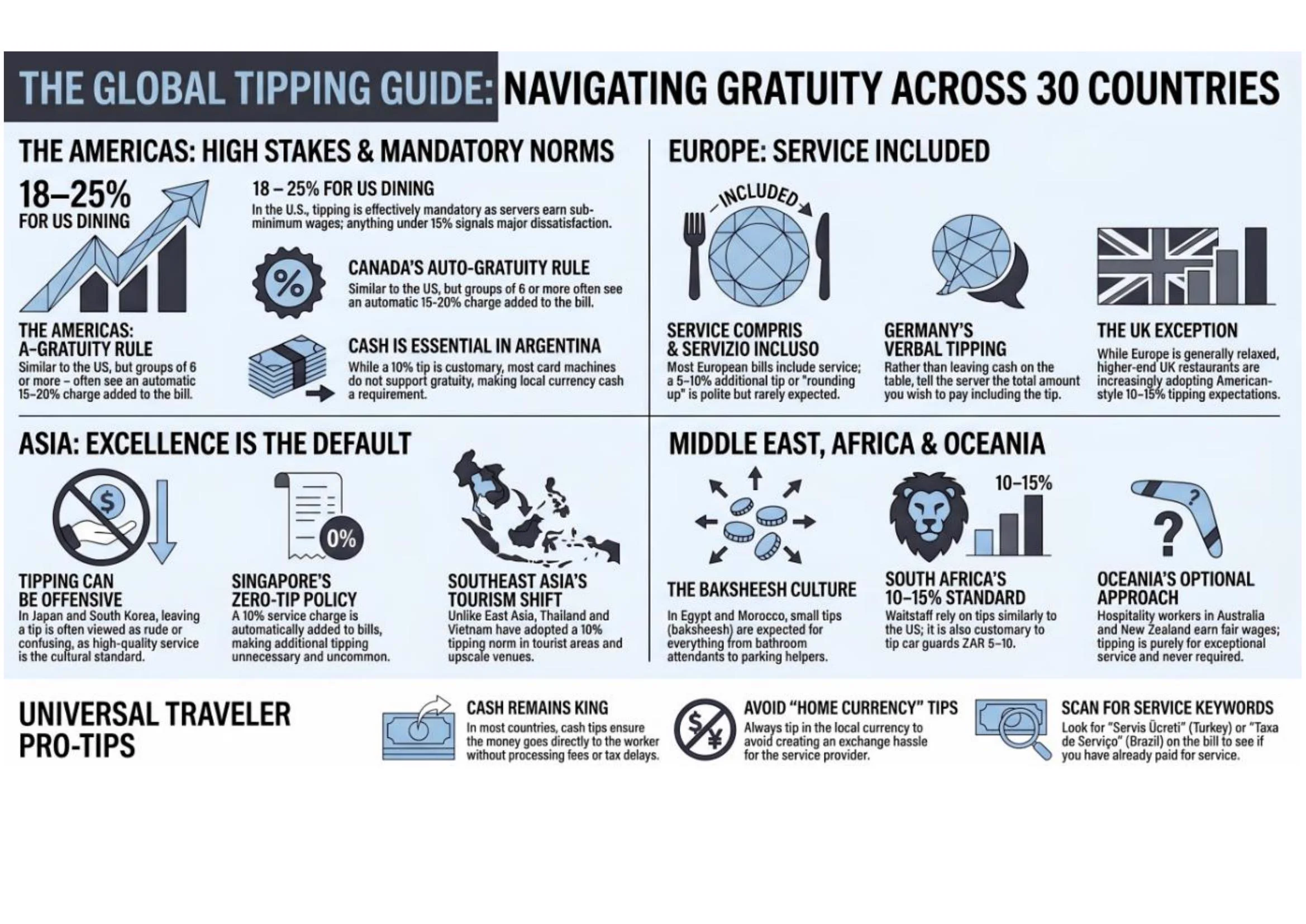
Most European countries include a service charge in the bill or pay hospitality workers a living wage. The result: tipping is appreciated but rarely expected. In France, service compris means tip is baked into the price — leaving a few coins is a nice gesture. In Germany, you tell the server the total you want to pay rather than leaving cash on the table. In Southern Europe and Turkey, 10% is considered generous. The key exception is the UK, where American-style tipping culture has crept in at higher-end restaurants.
Americas: Tip or Face Consequences
The United States and Canada run on tips — servers earn a sub-minimum wage with the expectation that tips make up the difference. Anything below 15% signals dissatisfaction, and 20–25% is the new normal at sit-down restaurants. In Latin America, the system is softer: Brazil auto-adds 10%, Colombia asks if you want to include it, and Mexico expects 10–15% but won't chase you for it. Argentina is cash-only for tips since card machines don't support them.
Asia: Don't Tip (With Exceptions)
Japan, South Korea, China, and Singapore share a common philosophy: excellent service is the baseline, not something you pay extra for. Tipping in these countries ranges from unnecessary to actively insulting. The exceptions are Southeast Asian countries like Thailand, Vietnam, and Indonesia, where tourism has introduced tipping culture — 10% at restaurants and rounding up for taxis is standard in tourist areas. India has a strong tipping culture, especially for hotel staff and drivers.
Middle East & Africa: Baksheesh and Beyond
Egypt's baksheesh culture means small tips are expected for virtually any service — from bathroom attendants to parking helpers. Morocco follows a similar pattern, especially for tour guides. The UAE auto-adds service charges but a few extra dirhams are appreciated. South Africa mirrors American tipping expectations, with waitstaff depending on tips and car guards expecting ZAR 5–10 for watching your vehicle.
Oceania: Relax
Australia and New Zealand pay hospitality workers fairly, so tipping is genuinely optional. Rounding up a taxi fare or leaving 10% for exceptional restaurant service is a nice surprise, not an obligation. Some fine-dining restaurants offer a tip line on the receipt, but nobody will judge you for leaving it blank.
Practical Tipping Tips for Travelers
Cash is King
Check for Service Charges
Digital Tipping
Avoid Currency Confusion
Frequently Asked Questions
Is it rude to tip in Japan?
Yes — tipping in Japan is generally considered rude or confusing. Excellent service is the cultural norm, and leaving money on the table may cause a server to chase you down to return it. At traditional ryokans, a cash gift in an envelope (called kokorozuke) is sometimes given, but this is rare and not expected by tourists.
How much should I tip in the United States?
In the US, 18–25% of the pre-tax bill is standard at sit-down restaurants. Servers earn a sub-minimum wage and depend on tips as their primary income. For takeout, 10–15% is increasingly common. Bartenders typically receive $1–2 per drink, and hotel housekeeping should receive $2–5 per night left with a note.
Should I tip in cash or by card when traveling?
Cash tips are preferred in most countries because they go directly to the service worker without delays, processing fees, or tax complications. In many countries — especially in Latin America, South Asia, and Africa — card tipping infrastructure simply doesn't exist. Carry small local-currency bills specifically for tips.
What is a service charge and does it replace tipping?
A service charge (servizio, service compris, taxa de serviço) is a percentage automatically added to your bill, typically 10–15%. In most European and Asian countries, this fully replaces tipping. However, in some places like the UAE or upscale London restaurants, a small additional tip is still appreciated. Always check your bill before adding more.
Do I need to tip taxi drivers and hotel staff abroad?
For taxi drivers, rounding up to the nearest convenient amount is the global default — rarely more than 10%. For hotel porters, $1–2 USD equivalent per bag is standard worldwide. Hotel housekeeping tips are common in the Americas but rare in Europe and Asia. Concierges typically receive tips only for special arrangements like hard-to-get reservations.
What I'd Do Differently Now
After that Tokyo dinner I started doing something small before every international trip: I look up the tipping norm for my first two or three countries and write it in the notes app under the destination. Not because I don't trust my memory, but because tipping decisions happen at exactly the wrong moment — you're paying, you're tired, and the person in front of you is waiting. Having "Japan: no tip; France: round up; US: 20% on pretax" already written down turns a small anxiety into a two-second lookup. The other thing I'd change: I now carry a small stack of low-denomination local bills specifically for tips, from the first taxi onward. Cards fail, terminals crash, and in half the countries in this guide the tip goes to the worker only if it's cash.
Tip With the Right Numbers
Tipping decisions happen at the register. Have the math and the cash ready.